Your documents already know the answer. You just can't ask them.
Answering real business questions means connecting facts across many documents. Clarionn builds the structure to do that from your documents, with no ontology to design or maintain.

It's Tuesday. A new export rule was announced last week, and your head of operations wants to know by Friday which of your suppliers it affects.
The answer exists somewhere in your company's documents: the regulation, supplier contracts, product specifications, and shipping records. Thousands of files, each containing a piece of the answer.
Someone could spend days reading through them, connecting the facts manually, and still miss something.
What if you could simply upload those documents and ask?
Documents contain more than text. They contain connected knowledge.
Most AI document search tools use Retrieval-Augmented Generation (RAG). They search for passages similar to your question and give those passages to an AI model to generate an answer.
This works well for questions where the answer is contained in a few passages.
But consider the supplier question. The regulation identifies restricted materials. Product specifications tell you which products contain those materials. Supplier contracts tell you who makes those products.
To answer, the system needs to connect facts across different documents, not simply find passages that resemble the question.
Knowledge graphs can represent those connections explicitly:
Supplier → manufactures → Product → contains → Material → restricted by → Regulation
Once these relationships are established, you can ask questions that require combining information across the entire collection.
But building a knowledge graph has traditionally required substantial preparation.
The hard part was never the graph. It was building and maintaining the ontology.
Before a knowledge graph can organise information, it needs an ontology: a blueprint describing what kinds of things exist, what properties they have, and how they relate.
For example, a supplier can manufacture a product, a product can contain a material, and a regulation can restrict that material.
Traditionally, organisations have had to design this structure themselves.
Domain experts and engineers identify the relevant concepts, define relationships, and agree on how information should be represented. When new concepts emerge, the ontology needs to be updated.
This creates three problems:
- Complex setup. You need to define the structure before you can start organising your knowledge.
- Rigid assumptions. Your ontology reflects what you anticipated when you designed it, not necessarily everything your documents contain.
- Ongoing maintenance. New documents, business processes, and terminology introduce concepts that must be incorporated into the existing structure.
The ontology becomes a project of its own.
Clarionn changes that.
Upload your documents. Clarionn builds the structure.
Clarionn automatically discovers the knowledge structure within your documents.
You don't need to tell it what entities to extract, which relationships matter, or how to organise them beforehand.
When you upload documents, Clarionn:
- Discovers the ontology. It identifies the types of entities, their properties, and the relationships described in your documents.
- Builds the knowledge graph. It extracts specific entities and facts, connecting information found across different documents.
- Organises the ontology. It groups related categories into hierarchies and checks for overlapping definitions to reduce unnecessary duplication.
- Evolves as your knowledge grows. When new documents introduce new concepts or relationships, Clarionn extends and refines the existing ontology rather than requiring you to redesign it manually.
- Answers questions with evidence. It uses the resulting structure to retrieve connected facts and provides supporting source passages so you can verify the answer.
No predefined ontology. No manual schema design. No ontology maintenance workflow for users. Just upload your documents.
And the structure isn't fixed after the first upload.
A collection of supplier contracts might initially teach Clarionn about suppliers, products, and agreements. Later, when you add regulatory documents, Clarionn can discover regulations, restricted materials, and new relationships connecting them to the information it already has.
Your knowledge graph grows alongside your documents.
This automatic evolution is central to Clarionn. Instead of forcing your documents into a structure designed in advance, the system learns and adapts the structure from the information it encounters.
Seeing it in action
We built a public demo using twelve documents about AI companies and their founders, including OpenAI, Anthropic, Google DeepMind, and others.
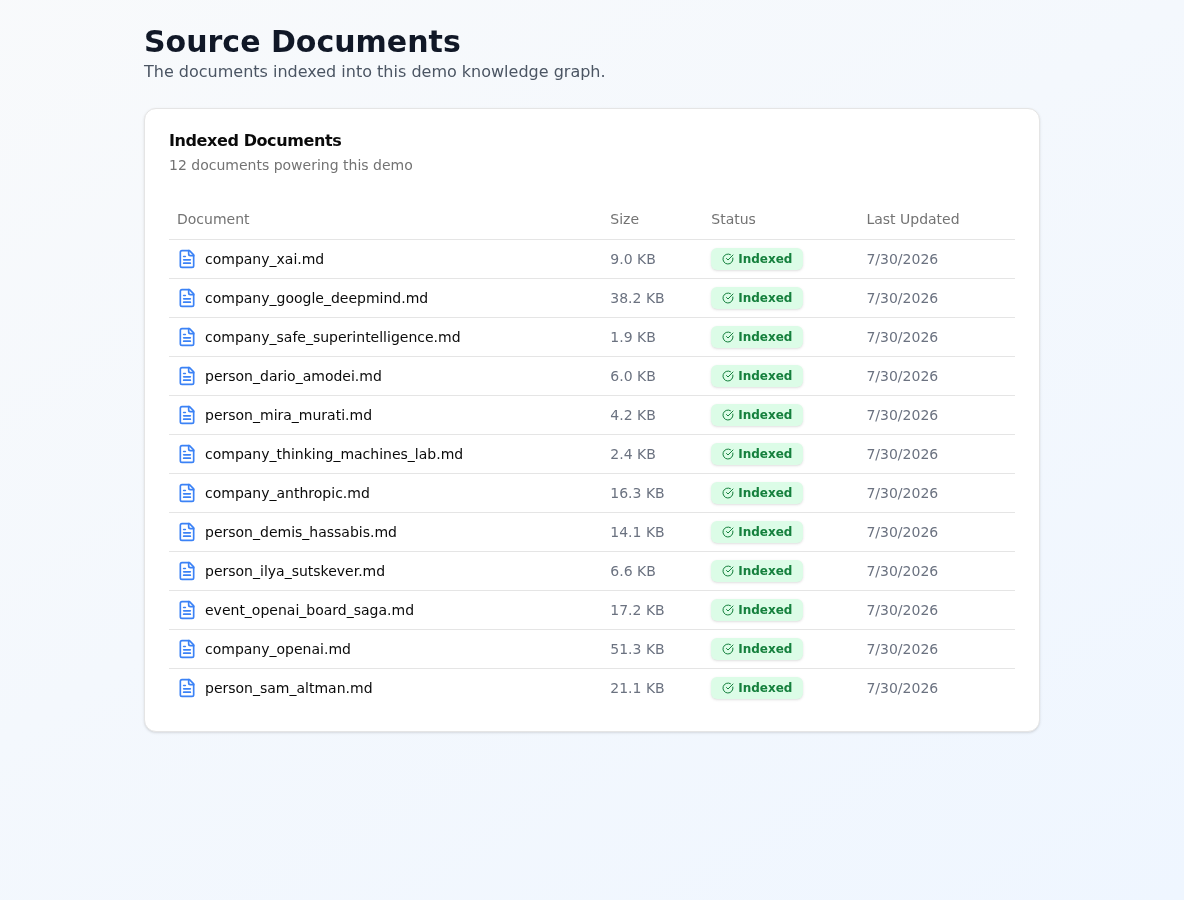
We didn't define an ontology beforehand.
From these documents alone, Clarionn discovered concepts such as people, organisations, technical systems, and the relationships between them.
It also identified useful properties, including a person's role or an organisation's founding year.
More specialised concepts, such as supercomputers and AI chips, were organised under broader categories.
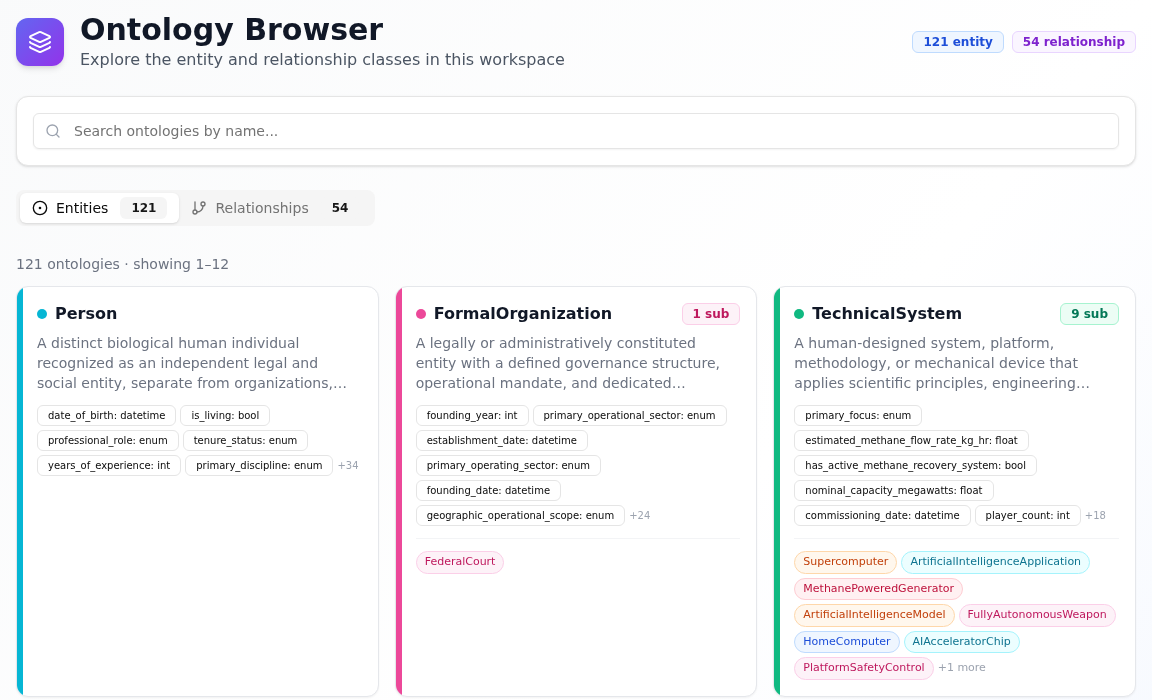
This ontology was generated from the documents themselves, without manually specifying the categories or relationships.
Now consider what happens when we ask a question that spans several documents:
Who founded Anthropic, Safe Superintelligence and Thinking Machines Lab, and what roles did each founder hold at OpenAI before?
No single document contains the complete answer.
One article might identify a company's founders. Another describes a founder's employment history. Answering the question requires connecting those facts across sources.
Clarionn uses its knowledge graph to identify the companies, find their founders, and trace their previous roles at OpenAI.
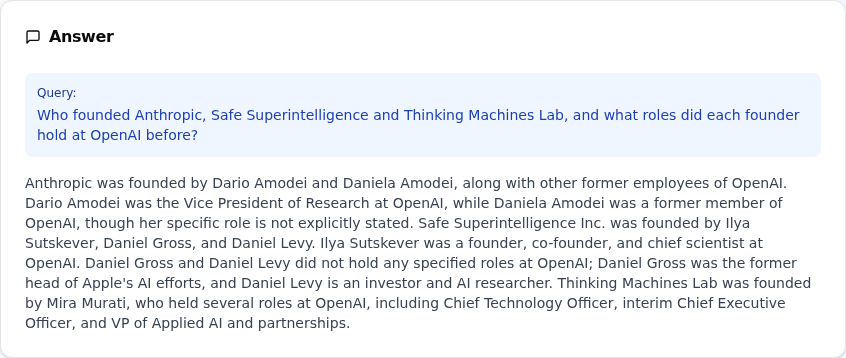
The result covers all three companies, including founders who did not previously work at OpenAI.
When the available documents do not establish a particular detail, Clarionn can also identify that gap rather than simply inventing an answer. For example, the demo reports that Daniela Amodei's previous role at OpenAI is not specified in the source documents.
You can inspect the relationships used to construct the answer:
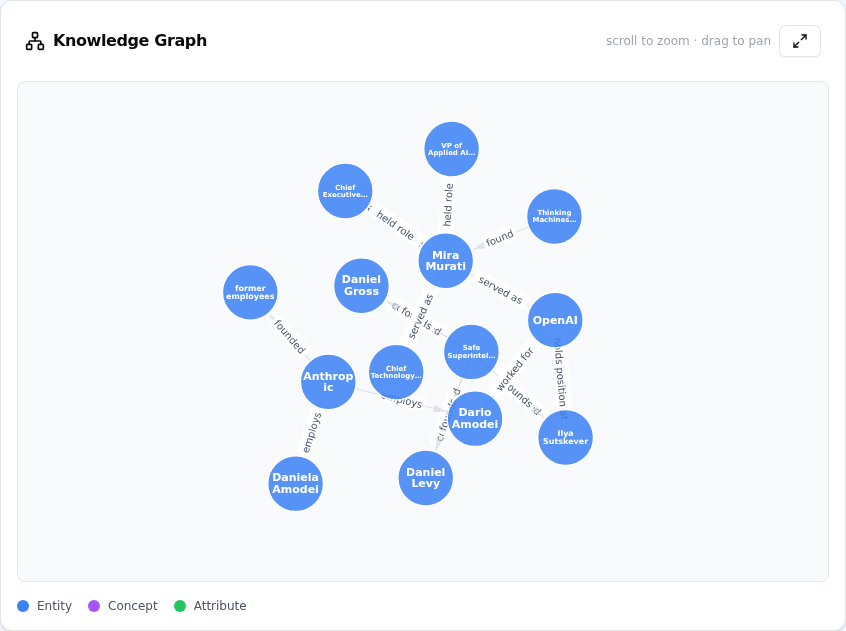
And verify the answer against the original evidence, retrieved from six different documents:
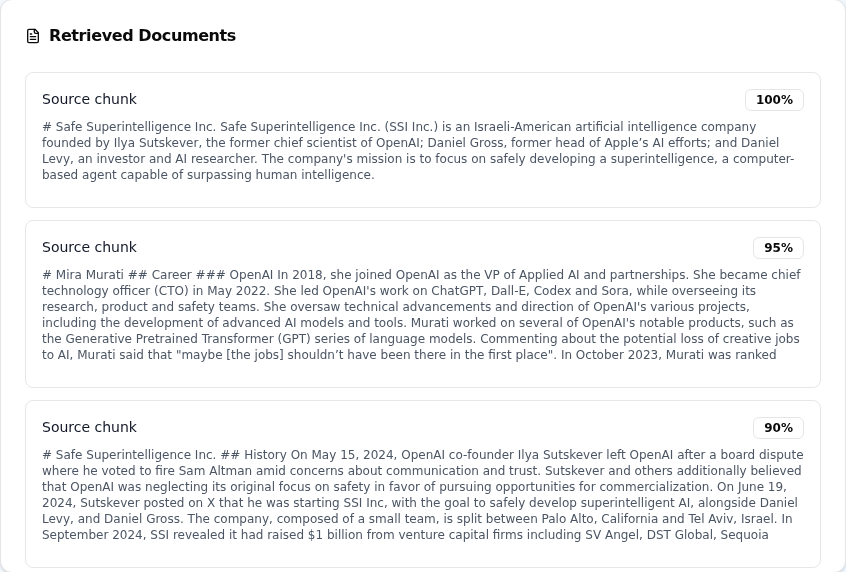
This is more than finding passages that sound relevant to a question. It is using a structured representation of knowledge to connect facts distributed across documents.
And importantly, you didn't have to build that structure yourself.
Your knowledge grows. Your ontology grows with it.
The twelve-document demo is intentionally small, making it easy to inspect how Clarionn works.
But consider what happens when the collection grows.
New suppliers appear. New products are introduced. New research brings unfamiliar terminology. New regulations create relationships that didn't exist before.
In a manually maintained knowledge graph, these changes can require updating the ontology and extraction rules.
Clarionn is designed to incorporate these changes automatically as new documents are processed.
It discovers new concepts, checks them against existing categories, and integrates them into the knowledge structure.
This doesn't eliminate the need to evaluate accuracy. Automatic ontology generation can introduce duplicates, incorrect relationships, or missing concepts, and these are important areas we actively measure.
But it removes the need for users to design and maintain the ontology themselves.
Your job is to provide the knowledge. Clarionn's job is to organise it and make it queryable.
Try Clarionn
Upload your documents. Let Clarionn discover and organise the knowledge inside them. Then ask questions that connect the facts across your collection.
Explore the public demo at app.clarionn.ai/demo.
In upcoming posts, we'll look more closely at how Clarionn automatically constructs and maintains its ontology, and share evaluation results showing where it succeeds and where it still needs improvement.